Showing posts with label definition. Show all posts

July 14, 2008

Elitist Storytelling Reported in Oklahoma! (The State, not the Musical)

Over at OKLAHOMA TELLERS, Marilyn Hudson calls out "storytelling elitism." She notes that this beast has two faces, one which hires and one which tells.

One side is elitist because it sees only one type of storytelling as "true storytelling" (theatrics vs. traditional, for example). Such storytelling must be defined with terms such as "artistic", "meaningful","educational", and "professional". The folksy stylings of a country teller would never be acceptable. The telling for the sheer joy of telling a saucy or funny tale would be frowned on. The less than perfect delivery, style, or presentation of a newbie would never be heard or seen.

In her full post, it seems she's directing this at those who hire storytellers. I suspect she has one or two specific producers in mind (but I don't know the Oklahoma scene well enough to say for sure), and I'm assuming she thinking of storytelling event producers.

But a producer who doesn't want an untried teller on their stage is no different than a movie theatre booking a Hollywood film over the neighbor kid's low-budget summer film project. To exclude novice storytellers from the stage at performance events where people have paid admission isn't elitist, it's good business sense.

Telling stories for the sheer joy of telling stories is great. I'm in favor of that too. It has its place at family gatherings, around campfires, and even, in the context of performance events, at open mics or story swaps.

The other side of the face is the storyteller who has come to believe that abstract artistry is superior to heartfelt communication. They have come to believe the rhetoric of the need for lighting, props, makeup, and a "brand". They have allowed storytelling to be defined by large stage theater instead of standing on its own -and very -unique feet.


I don't know any storyteller that believes that abstract artistry is superior to heartfelt communication. (Neither do I know any that insist on lighting, props, and makeup... but then, I'm not familiar with the Oklahoma storytelling landscape.) I do know solo performers who are accomplished storytellers who do prefer to tell in theatres, use a script, but they don't call it storytelling. They insist on calling it theatre.

In an effort to parse what Marilyn might be reacting to, I found this entry of hers on a different blog:
In recent years, more and more touches of theatrics have been added to be "crowd pleasers" under the assumption that "today's child or audience" needs action and variety....
I have also seen a lot of meaningless shouting, audience participation, and over the top acting in some storytellers that was fun to watch but was a lot like eating spun sugar....it left you feeling a little empty......it was junk food that left nothing for the mind or the heart to think on and discover days later....


Every storyteller has a different style. And each teller may be at a different place along their learning curve (so that, for example, they haven't mastered the use of "meaningless shouting" in their stories... er, or rather, the appropriate use of volume and physical energy). And we all have our preferences. But I don't meet many storytellers who push their style as better than others.

But, if Oklahoma is somehow fomenting a cadre of uppity storytellers dedicated to the notion that storytelling should be defined by loud and eye-catching shenanigans performed without regard to the needs of the audience, I'm with you Marilyn, let's send those elitists back to the vaudeville circuit where they belong.

April 17, 2008

Reclaiming "Storyteller" as a Label

Over at Ning, the perennial question of how to define storytelling came up around one corner of the virtual water cooler, as Katie Knudsen asked whether we need to expand our definition of storytelling or hold fast to our tradition. I responded with an answer that goes on and on and on, but focused on the role of the event producer, not the performer, as the one who holds the key to definition. Here's an excerpt:

My point is: storytelling is bigger than "roots storytelling" represented by the festival circuit, and its bigger than "personal storytelling" represented by the Moth. And you certainly can segment your audience and produce events that showcase one sliver of storytelling.... nothing wrong with that.

What doesn't make sense is trying to claim an umbrella term as your own.

Imagine if Milton Berle had tried to claim "television" as the genre for the Texaco Star Theater show, and got all the other comedian hosted variety shows to claim "well, what we do is television." Those soap operas, those news shows, they're not "television."

Imagine if track and field competitors tried to claim that basketball players weren't "athletes" because they used a ball, and had to use teammates.

I'd like to see an event producer create a series or even a festival that is truly open to all forms of storytelling.

You can read my entire post and discussion here.

December 23, 2007

When is Storytelling Not Storytelling?

Before I continue with the shout-outs to various other blogs and web sites, I have to jump in with this reflection based on both an issue Sean Buvala raises about the defintion of storytelling, and a brilliant night of storytelling my wife and I caught last week.


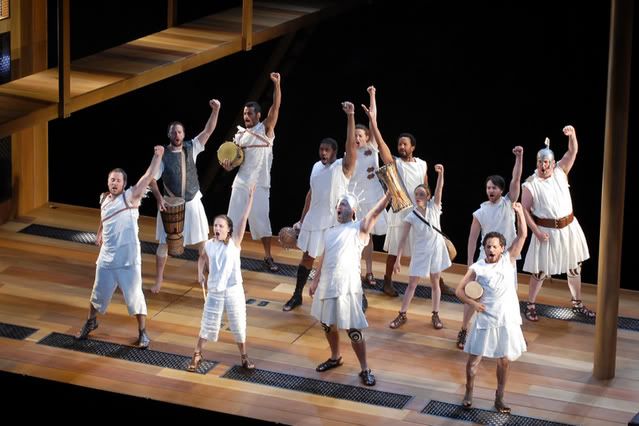
Mary Zimmerman's adaptation of The Argonautika, the ancient poem that re-tells the tale of Jason and the Golden Fleece, has been playing in town, at Berkeley Repertory Theatre. Mary's an old college friend and I'd go see anything she's directed. The two-and-a-half hour long production has been wowing crowds and critics alike.

Critics call the production full of theatrical wizardry... but Pat Craig of the Contra Costa Times, I think captured the show's appeal best: "...when writer-director Zimmerman spins the tale, it conjures memories less of musty schoolbooks and more of Saturday afternoon matinees and midnight campfire stories."

My wife and I both found the show one of the best performance events we've ever seen. But despite the fact that the show was produced in a proscenium theatre, I'd be hard pressed to call it a "play."

Sure, there were actors. Costumes. Lighting. A set. Excellent music. And props. And clearly, the performers had learned their lines. But the whole point of the evening was not to show off acting chops, or a well-written script. The whole point of the evening was to gather people in a room to share a story.

And in this, the effort was wildly successful.

It took a dozen people on stage (and a host more offstage) to share the tale of Jason and Medea. And Mary chose to use puppets, percussion, stagecraft, music, and drama to help in the telling of the story (But still, we, the audience members, were co-creators of the images of the story... the stagecraft did not try to re-create, but only suggest dragons, armies, storms, armadas).

That doesn't make it any less storytelling, in my view.

Granted, this type of storytelling does not fit into the storytelling circuit's model of concerts and festivals.

I can think of one, maybe two, "professional storytellers" who might, might, be able to get the same emotional wallop with this story.

The story was thrilling. It brought to life an ancient tale, while acknowledging our own modern day perspectives on fate, on war, on glory, on storytelling. It even acknowledges that we, as an audience, already know how Jason and Medea end up (most people in this theatre crowd knew the story of Medea... whether they knew the story of Jason and the Golden Fleece before entering the theatre was debatable...
I only knew it from the 1963 sword-and-sandals movie from Columbia Pictures (filmed in the miracle of Dynarama!) featuring the astonishing stop-motion animation of Ray Harryhausen. And you can be sure that Hollywood's version didn't exactly stick to the original story.)

For me, a listener who prefers ancient tales to "the day grandpa fell off the ladder," this was a remarkable evening of ensemble storytelling.

For me, it certainly falls within Sean Buvala's definition of storytelling:
Storytelling is the intentional sharing of a narrative through words and actions for the benefit of both the listener and the teller.


Some folks will say, well, no, it's theatre, not storytelling. They point to the costumes, the lights, the script. The sound design, the set, the choreography.

To me, that's like saying that modern dance isn't dance because it's not ballet. That Elvis Presley's oeuvre wasn't music because he didn't do it like Benny Goodman.

I understand the main objection of storytelling purists: that the conventions of theatre don't allow for spontaneous interplay with and reciprocal feedback with the audience.

But I was there. Sitting in a darkened space, with six hundred other people, transfixed, as an ensemble told us about Jason, and Pelias. Athena and Hera. Hercules, Castor and Pollux. Phineas. Aeetes. Medea.

They told us a story.

-----

BTW, catch the 30-second trailer for the show on YouTube.