Showing posts with label myth. Show all posts

November 23, 2010

Shout Out: Dizzy Miss Lizzy's Roadside Revue - Finn McCool

As an out-of-towner at the Capital Fringe Festival in Washington DC this past July, I had minimal information to go on in selecting which of the 137 productions to see. I did what research I could, visiting performer's websites, paying attention to local reviews... but with limited time and money, I mainly chose based on content: what was the show about? When I discovered, on the Fringe web site, that there would be a "post-apocalyptic, raucous, rock and roll, retelling of the Irish legend: Finn Mc Cool" by a group called Dizzy Miss Lizzy's Roadside Revue, I made time in my schedule.


Now, as a storyteller, I'd certainly heard of Fionn mac Cumhaill (my Celtic storytelling colleagues would never forgive me if I didn't use the Gaelic spelling). Over the years, I had heard a tale here or there of this Irish warrior-king of the Fianna, but I'd never read or heard Finn's origin story (And, truth be told, hearing one too many versions of the tall tale where Finn meets Cuchulainn did not inspire me to seek it out). So now here, I hoped, in DC, I'd get to hear it... gathered in the darkness with strangers to hear a story.

Only we weren't gathered in the dark. We were in a portable tent (a good omen for storytelling) set up as a temporary venue constructed for the duration of the Fringe, with a massive soundsystem (so it could double as the party spot) and a roof to keep the summer thundershowers off the outdoor thrust stage (seating on three sides). Though not air-conditioned (and in DC in July, that fact made it into every review of each show that played there), the venue was conveniently located next to the Fringe bar.

The stacks of amps, full drum kit, microphones, and numerous electric guitars on the stage made me realize this was not going to be your average storytelling set. The programs and postcards for the show set up the frame that the legend of Finn McCool would be presented as a rock and roll revue with six bands on the bill (With just 8 performers in the show, the "bands" were created with costume changes and sometimes switching up instruments).

And so, in music and song, we were treated to Finn's origin story: how his father, leader of the Fianna warriors, was killed by Goll Mac Morna; how his mother gave him up to be raised in secret by the druidess Bodhmall and the warrior woman Liath Luachra; and how Finn obtains the Salmon of Wisdom during his service to the poet and teacher Finneces, which enables him to claim his place as leader of the Fianna and defeat Goll.

Plot points were kept to a minimum to let the music do the heavy lifting of the show: and it worked. The music ranged from ballads (both acoustic and power) to art rock to stadium rock to blues... the troupe used a wide musical palette to vary the emotions through the arc of the story, and the audience cheered every time they recognized a trope (e.g. guitar solos, power duets, drinking song choruses). I was also impressed by the quality of the performers (though the show had a thrown-together, held-together-with-duct-tape thrift-store aesthetic, everyone in it, from the costumer to the composer to the performers had bona fide professional theatre chops). The singers--most with musical theatre backgrounds and many recognized by local critics and peers with theater awards--really delivered, as the variety of songs explored a vast emotional range.
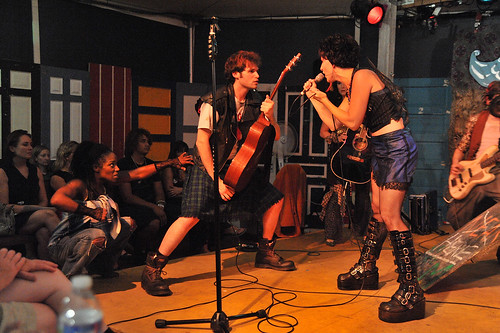
Finn_McCooll_CapFringe10_378
Pictured: Audience and Felicia Curry, Matthew Schleigh (as Finn), and Debra Buonaccorsi. Photo copyright 2010 by Paul Gillis Photography; used by permission

This show called to mind ancient traditions of epic storytelling, where the community gathered to listen to stories of heroes, and achieve an altered state of consciousness. At the Fringe, our consciousness was being altered not only by our willingngess to engage with the drama, but the soaring melodies and the volume of the music, but by the venue's heat, humidity, and proximity to the performers (no one was farther than 15 feet from the stage). The availability of alcohol helped, too.

Furthermore, the posturing and tropes of rock and roll passed for modern day versions of the ritual required for the sharing of such epics. So, while in an oral culture, everyone in the audience would know the story (e.g. the Ramayana) , this performance gave the audience a story in a style everyone knew, though many weren't familiar with the characters or plot.

The creators of the show made sure that before and after each song, characters explained who they were, what they wanted, and where they were going. The extra exposition here was necessary for an audience unfamiliar with this epic. Some reviewers complained that the exposition muddied the dramatic arc, but I found it was not only necessary to get the story out, but actually a clever way to continue to build the trance state you want in an epic storytelling session (My own theory: by giving the logical brain narrative, we're compelled to engage more--to find out what happens next-- which allows us to continue in the performance environment towards a trance state).

Me? I’m predisposed to enjoying epic narration (my list of most enjoyable theatrical experiences include narration heavy shows like lookingglass theatre’s Argonautika and Metamorphoses, and Mabou Mines’ Peter and Wendy… and to which, I’m adding this production), so my enthusiasm for this show might differ from the typical DC theatregoer, but all in all... I found it a thoroughly delightful way to engage with an ancient myth, and in terms of artistic craft, an inventive and masterfully crafted performance experience.

If you're not in the DC area (and won't get a chance to see future productions of Finn McCool), you can get a mere taste of it: Check out this Flickr slide show with Paul Gillis' photos (link) while you play music from the show via DMLRR's page on Myspace. (The versions there are clean, but nowhere near as thrilling as hearing them performed live by sweaty rock and rollers a stone's throw from you!)

Coming up soon: an interview with one of the show's creators, Debra Buonaccorsi

April 04, 2009

Notes from the 2009 Going Deep Storytelling Retreat

Blogger Hope Baugh of Indiana, over at her Indy Theatre Blog, gives us a report from the 2009 Going Deep: The Long Traditional Storytelling Retreat. (She did the same with last year's event, as well).

Going Deep not only treads new ground in the storytelling circuit (by focusing on a niche market of epic stories, and setting up the logistics of the event accordingly, i.e., making it a retreat rather than a series of one-off evening concerts).

Hope has posted her reflections on the three stories presented during the course of the retreat:
I especially appreciate her careful notes on the workshops that followed each performance-- they give a more rounded context to the storytelling event and allow us a glimpse into the artistic process for each performer, as well as a sense of how a retreat differs from a standard festival.

I should also point out that storyteller Priscilla Howe, one of the co-founders of the retreat, has posted her reflections of this year's event over on her blog.

And Sean Buvala of Storyteller.net has an .mp3 interview with retreat founders Priscilla Howe and Liz Warren over at the Storyteller.net Amphitheater (from 2006?).

December 23, 2007

When is Storytelling Not Storytelling?

Before I continue with the shout-outs to various other blogs and web sites, I have to jump in with this reflection based on both an issue Sean Buvala raises about the defintion of storytelling, and a brilliant night of storytelling my wife and I caught last week.


Mary Zimmerman's adaptation of The Argonautika, the ancient poem that re-tells the tale of Jason and the Golden Fleece, has been playing in town, at Berkeley Repertory Theatre. Mary's an old college friend and I'd go see anything she's directed. The two-and-a-half hour long production has been wowing crowds and critics alike.

Critics call the production full of theatrical wizardry... but Pat Craig of the Contra Costa Times, I think captured the show's appeal best: "...when writer-director Zimmerman spins the tale, it conjures memories less of musty schoolbooks and more of Saturday afternoon matinees and midnight campfire stories."

My wife and I both found the show one of the best performance events we've ever seen. But despite the fact that the show was produced in a proscenium theatre, I'd be hard pressed to call it a "play."

Sure, there were actors. Costumes. Lighting. A set. Excellent music. And props. And clearly, the performers had learned their lines. But the whole point of the evening was not to show off acting chops, or a well-written script. The whole point of the evening was to gather people in a room to share a story.

And in this, the effort was wildly successful.

It took a dozen people on stage (and a host more offstage) to share the tale of Jason and Medea. And Mary chose to use puppets, percussion, stagecraft, music, and drama to help in the telling of the story (But still, we, the audience members, were co-creators of the images of the story... the stagecraft did not try to re-create, but only suggest dragons, armies, storms, armadas).

That doesn't make it any less storytelling, in my view.

Granted, this type of storytelling does not fit into the storytelling circuit's model of concerts and festivals.

I can think of one, maybe two, "professional storytellers" who might, might, be able to get the same emotional wallop with this story.

The story was thrilling. It brought to life an ancient tale, while acknowledging our own modern day perspectives on fate, on war, on glory, on storytelling. It even acknowledges that we, as an audience, already know how Jason and Medea end up (most people in this theatre crowd knew the story of Medea... whether they knew the story of Jason and the Golden Fleece before entering the theatre was debatable...
I only knew it from the 1963 sword-and-sandals movie from Columbia Pictures (filmed in the miracle of Dynarama!) featuring the astonishing stop-motion animation of Ray Harryhausen. And you can be sure that Hollywood's version didn't exactly stick to the original story.)

For me, a listener who prefers ancient tales to "the day grandpa fell off the ladder," this was a remarkable evening of ensemble storytelling.

For me, it certainly falls within Sean Buvala's definition of storytelling:
Storytelling is the intentional sharing of a narrative through words and actions for the benefit of both the listener and the teller.


Some folks will say, well, no, it's theatre, not storytelling. They point to the costumes, the lights, the script. The sound design, the set, the choreography.

To me, that's like saying that modern dance isn't dance because it's not ballet. That Elvis Presley's oeuvre wasn't music because he didn't do it like Benny Goodman.

I understand the main objection of storytelling purists: that the conventions of theatre don't allow for spontaneous interplay with and reciprocal feedback with the audience.

But I was there. Sitting in a darkened space, with six hundred other people, transfixed, as an ensemble told us about Jason, and Pelias. Athena and Hera. Hercules, Castor and Pollux. Phineas. Aeetes. Medea.

They told us a story.

-----

BTW, catch the 30-second trailer for the show on YouTube.