Great story or great storyteller: which do you prefer?
(hat tip to Sean, who reminded me that this question was first put into my noggin by Priscilla Howe, who asked the question on her Storytelling Notes blog early in 2009: link)
Showing posts with label stories. Show all posts
Showing posts with label stories. Show all posts
June 11, 2010


March 09, 2009
Storytelling with Twitter? I don't think so.
Question: is Twitter, the social messaging utility, a good platform for storytelling?
Short Answer: No.
Not that I heard anyone say it was. But with Twitter being the "in" tool this year, and storytellers jumping in, I wanted to add my two cents.
Do I use Twitter? Yes. I appreciate its functionality for those times when I need to be connected in real time. I'm impressed that its fans have been able to build online relationships despite the tools built in limitations, namely, the 140 character limit for each message.
I don't see these two primary features (real-time messaging, and limited length) as essential to storytelling.
That there's a tool, ie Twitter, that lets me receive messages in real-time from friends, relations, colleagues, celebrities, politicians, and NASA missions is cool. I like being connected, being reminded on these people-- those that I have a relationship with in real life, well, it helps "grease the wheel" of that relationship during that time when we're not in contact. But Twitter is about the "what I'm doing now" not about "remember when we..." or "once upon a time."
Could you use Twitter to tell a story? Yes, of course. But it's an inelegant tool.
(I'll grant that when it comes to stories for journalism, however, Twitter is useful as a tool for gathering information of stories-as-they-happen, as events in San Diego, Mumbai, and the Hudson River have shown us)
But in terms of spinning narratives: using Twitter is like selecting a toothpick to paint on a canvas that's meant to fill a room.
Partly it's the 140 character limit. Now, Flash fiction is nothing new. Storytellers from Vishnu Sarma to Aesop to Jesus were using the short short form long before the publishing world took a shine to very short tales in the 1990s. Setting limits, even arbitrary ones, can prompt some very creative output, so I can see the appeal of using Twitter to share these mini works of fiction.
Some of my favorites:
Two writers in particular, I've found, who use Twitter to write nanofiction. I would categorize their work as character sketches and platforms --more seeds of stories that could be than actual beginning-middle-end kernels, but sometimes worth a look:
@arjunbasu
@nickwarren (I especially like Nick's use of first person, since it plays within the Twitterverse milieu nicely)
Smith Magazine, home of the six word story, set the bar higher (or tighter, I guess. You can fit a lot more than 6 words on Twitter). It's difficult to pull off a good six-word story, so you have to wade through a lot of dross to find the gems, and then, there's not so much a haiku feeling as a "wish they served dinner instead of hors d'oeuvres"... still, Twitter seems an excellent channel for them to utilize: @smithmag
Portland Story Theater sneaks around the limitations of length and genre with a serial format:
@pdxstorytheater
Do you follow anyone on Twitter that is creating interesting stories? Post them in the comments!
(And just so we're clear: "creating interesting stories" does NOT mean "promoting their business" (story-based or otherwise)
-----
So maybe you're not looking for Twitter to deliver bite-sized stories. Maybe you just think it'd be cool (for this year anyway) to receive real-time messages from working storytellers. In that case, here are some current storytellers with active or semi-active Twitter accounts:
(Yes, I left out a bunch of "organizational narrative" and "corporate storytellers" who are very active on Twitter. That's by design. They've got their own blogs. When the day comes that they tell a story around a campfire, then I'll add them to my list here.)
Short Answer: No.
Not that I heard anyone say it was. But with Twitter being the "in" tool this year, and storytellers jumping in, I wanted to add my two cents.
Do I use Twitter? Yes. I appreciate its functionality for those times when I need to be connected in real time. I'm impressed that its fans have been able to build online relationships despite the tools built in limitations, namely, the 140 character limit for each message.
I don't see these two primary features (real-time messaging, and limited length) as essential to storytelling.
That there's a tool, ie Twitter, that lets me receive messages in real-time from friends, relations, colleagues, celebrities, politicians, and NASA missions is cool. I like being connected, being reminded on these people-- those that I have a relationship with in real life, well, it helps "grease the wheel" of that relationship during that time when we're not in contact. But Twitter is about the "what I'm doing now" not about "remember when we..." or "once upon a time."
Could you use Twitter to tell a story? Yes, of course. But it's an inelegant tool.
(I'll grant that when it comes to stories for journalism, however, Twitter is useful as a tool for gathering information of stories-as-they-happen, as events in San Diego, Mumbai, and the Hudson River have shown us)
But in terms of spinning narratives: using Twitter is like selecting a toothpick to paint on a canvas that's meant to fill a room.
Partly it's the 140 character limit. Now, Flash fiction is nothing new. Storytellers from Vishnu Sarma to Aesop to Jesus were using the short short form long before the publishing world took a shine to very short tales in the 1990s. Setting limits, even arbitrary ones, can prompt some very creative output, so I can see the appeal of using Twitter to share these mini works of fiction.
Some of my favorites:
This bit of magical realism/spy novel and this melodrama from David Vanadia.
This retelling of a fable from Jerrold Connors.
Two writers in particular, I've found, who use Twitter to write nanofiction. I would categorize their work as character sketches and platforms --more seeds of stories that could be than actual beginning-middle-end kernels, but sometimes worth a look:
@arjunbasu
@nickwarren (I especially like Nick's use of first person, since it plays within the Twitterverse milieu nicely)
Smith Magazine, home of the six word story, set the bar higher (or tighter, I guess. You can fit a lot more than 6 words on Twitter). It's difficult to pull off a good six-word story, so you have to wade through a lot of dross to find the gems, and then, there's not so much a haiku feeling as a "wish they served dinner instead of hors d'oeuvres"... still, Twitter seems an excellent channel for them to utilize: @smithmag
Portland Story Theater sneaks around the limitations of length and genre with a serial format:
@pdxstorytheater
Do you follow anyone on Twitter that is creating interesting stories? Post them in the comments!
(And just so we're clear: "creating interesting stories" does NOT mean "promoting their business" (story-based or otherwise)
-----
So maybe you're not looking for Twitter to deliver bite-sized stories. Maybe you just think it'd be cool (for this year anyway) to receive real-time messages from working storytellers. In that case, here are some current storytellers with active or semi-active Twitter accounts:
Baba the Storyteller: @Djeliba
Hope Baugh: @Hope_Baugh
Karol Brown: @Browntones
Buck P Creacy: @BuckPCreacy
Lynn Duddy: @storywoman
EthNohTec: @ethnohtec
Tim Ereneta: @tereneta
Stephen Hollen: @mountainstories
Sean Buvala: @storyteller
Terry Free: @TerryFree
Rachel Hedman: @StorytellingAdv
Priscilla Howe: @priscillahowe
Dale Jarvis: @DaleJarvis
Carol Knarr: @ckanrr
Debra Olson-Tolar: @storytolar
Laura Packer: @storylaura
Ellouise Schoettler: @ellouisestory
Tim Sheppard: @TimSheppard
Dianne de las Casas: @storyconnection
BZ Smith: @bzsmith
Teresa Clark: @teresaclark
Limor Shiponi: @Storyteling
David Vanadia @Vanadia
Eric Wolf: @Ericwolf2
(Yes, I left out a bunch of "organizational narrative" and "corporate storytellers" who are very active on Twitter. That's by design. They've got their own blogs. When the day comes that they tell a story around a campfire, then I'll add them to my list here.)
December 23, 2008
Story Swapping Between Cultures, Part 2
On the second day of our visits to Irula villages, tour organizer Robert asked me about the experience, both to check in with me but also to get feedback on the tour itself. (It had been a primary goal of Robert and Nancy to get us out to a rural setting and to sit and swap stories in a non-performance platform context).
I told Robert that to listen to stories while sitting in the shade of a tree in a rural village in India was, in one sense, exactly why I had come on the trip. That very morning, in fact, as we were being served coconut water (a young coconut with a straw in it) and listening to stories, I nudged the person next to me. "We're listening to stories under a banyan tree. In India. Can you believe it?"
 Banyan tree storyswapping venue,
Irula village near Chengalpettu,
photo by Jeff Byers.
After all the hassle of arranging travel, the long trip itself, the jet lag, the crash course in narrative arts of Tamil Nadu (including epic songs, the Mahabharata, bharatanatyam, and kattaikkuttu), sightseeing, living out of a suitcase, language barriers, and the media frenzy leading up to the November 4th election-- after all that, the story swapping in villages was a chance to experience life in the present.
A chance to pause... not just to enjoy stories, but to live life in real time.
Granted, it's not necessary to travel 9,000 miles away from home to grab a respite from the hustle and bustle of a modern lifestyle. And certainly to make a such a journey for the purposes of experiencing storytelling was a gamble of expectations. None of us, including the tour organizers, knew how the story swapping would work out.
(I can imagine the conversation at the tourism bureau: "The Americans want to go where?... They're coming all this way and want to visit the tribes... just to listen to stories?... What on earth for?")
So there we were. After brief tours of the villages, we'd gather in a group. We would sit and listen. Our village hosts graciously served us tea, and snacks. We whiled away the hours listening to stories, and some of our group had the chance to tell stories to the villagers.
In contrast to the epic stories of the Hindu religion we'd experienced in Chennai and the kattaikkuttu school, here we heard animal fables and local sacred stories, mostly from the women. One notable exception was when the village headman condensed a four hour sacred story into a 45 minute telling for us... despite the editing, he still found the story so powerful that he went into a trance state at the emotional peak of the story (We followed the lead of his wife and just waited patiently for him to return to us).
In the village with the banyan tree, locals sheepishly admitted they didn't know any traditional stories. Oakland storyteller Liz Nichols then asked them, through a translator, if they might share any stories about their grandparents. We quickly got two fascinating local legends about relatives who could go into trance states: one story about a woman who could predict epidemics in this way, and another about a man who could summon tigers.
We didn't speak their language, we could barely fathom their way of life. We got only a quick overview of their recent history: The Irula are a tribal community with thousands of years of indigenous knowledge of the forest, but the villages we visited were government resettlement projects. In recent decades, forest conservation laws made extraction of forest resources illegal, and apart from a few worthy efforts of non-governmental organizations to develop traditional knowledge into economic engines (snake venom extraction labs, herbal plant nurseries), most of the Irula are agricultural day laborers. Some of the women told us that they never took visited the nearest town (just a few kilometers away), because they could not read the numbers on the buses or the signs in the shops. If they braved the journey, they required their school-educated children to guide them.
But we sat down with them and listened. Sometimes life in real time doesn't provide the ideal venue for swapping stories. Real life can mean heat, humidity, dust, mud, goat droppings, snakes (the Irula are known as snake-catchers, and several men were happy to show off their recent finds), cell phones (in rural communities, it's easier to leapfrog landlines), children coming home from school. I recently played back video from one swapping session and what you can hear most clearly is the bleating of the village goats and clucking of chickens. Some of the younger children wanted to touch us white folks, or engage in various versions of peek-a-boo. During one swap, a group of boys realized the grown ups were otherwise engaged and began throwing rocks at each other just outside the storytelling circle. In another, the village alcoholic, attentive to the stories, felt compelled to make the session an interactive one. His outbursts were deftly and good-naturedly handled by our translator.
Sitting under the trees in rural India was picturesque, but it's also far from luxurious. Some of our group had health issues, which meant sitting cross-legged on a straw mat on the ground for two hours was far from ideal (chairs had to be hauled in from homes and schoolrooms).
But despite the challenges... of culture, of language, of lifestyle, of venue... such an experience really drove home the essential elements of what it means to be a human being. Because despite all the differences, were able to find common ground simply by being willing to listen to and share stories.
I told Robert that to listen to stories while sitting in the shade of a tree in a rural village in India was, in one sense, exactly why I had come on the trip. That very morning, in fact, as we were being served coconut water (a young coconut with a straw in it) and listening to stories, I nudged the person next to me. "We're listening to stories under a banyan tree. In India. Can you believe it?"
 Banyan tree storyswapping venue,
Irula village near Chengalpettu,
photo by Jeff Byers.
After all the hassle of arranging travel, the long trip itself, the jet lag, the crash course in narrative arts of Tamil Nadu (including epic songs, the Mahabharata, bharatanatyam, and kattaikkuttu), sightseeing, living out of a suitcase, language barriers, and the media frenzy leading up to the November 4th election-- after all that, the story swapping in villages was a chance to experience life in the present.
A chance to pause... not just to enjoy stories, but to live life in real time.
Granted, it's not necessary to travel 9,000 miles away from home to grab a respite from the hustle and bustle of a modern lifestyle. And certainly to make a such a journey for the purposes of experiencing storytelling was a gamble of expectations. None of us, including the tour organizers, knew how the story swapping would work out.
(I can imagine the conversation at the tourism bureau: "The Americans want to go where?... They're coming all this way and want to visit the tribes... just to listen to stories?... What on earth for?")
So there we were. After brief tours of the villages, we'd gather in a group. We would sit and listen. Our village hosts graciously served us tea, and snacks. We whiled away the hours listening to stories, and some of our group had the chance to tell stories to the villagers.
In contrast to the epic stories of the Hindu religion we'd experienced in Chennai and the kattaikkuttu school, here we heard animal fables and local sacred stories, mostly from the women. One notable exception was when the village headman condensed a four hour sacred story into a 45 minute telling for us... despite the editing, he still found the story so powerful that he went into a trance state at the emotional peak of the story (We followed the lead of his wife and just waited patiently for him to return to us).
In the village with the banyan tree, locals sheepishly admitted they didn't know any traditional stories. Oakland storyteller Liz Nichols then asked them, through a translator, if they might share any stories about their grandparents. We quickly got two fascinating local legends about relatives who could go into trance states: one story about a woman who could predict epidemics in this way, and another about a man who could summon tigers.
We didn't speak their language, we could barely fathom their way of life. We got only a quick overview of their recent history: The Irula are a tribal community with thousands of years of indigenous knowledge of the forest, but the villages we visited were government resettlement projects. In recent decades, forest conservation laws made extraction of forest resources illegal, and apart from a few worthy efforts of non-governmental organizations to develop traditional knowledge into economic engines (snake venom extraction labs, herbal plant nurseries), most of the Irula are agricultural day laborers. Some of the women told us that they never took visited the nearest town (just a few kilometers away), because they could not read the numbers on the buses or the signs in the shops. If they braved the journey, they required their school-educated children to guide them.
But we sat down with them and listened. Sometimes life in real time doesn't provide the ideal venue for swapping stories. Real life can mean heat, humidity, dust, mud, goat droppings, snakes (the Irula are known as snake-catchers, and several men were happy to show off their recent finds), cell phones (in rural communities, it's easier to leapfrog landlines), children coming home from school. I recently played back video from one swapping session and what you can hear most clearly is the bleating of the village goats and clucking of chickens. Some of the younger children wanted to touch us white folks, or engage in various versions of peek-a-boo. During one swap, a group of boys realized the grown ups were otherwise engaged and began throwing rocks at each other just outside the storytelling circle. In another, the village alcoholic, attentive to the stories, felt compelled to make the session an interactive one. His outbursts were deftly and good-naturedly handled by our translator.
Sitting under the trees in rural India was picturesque, but it's also far from luxurious. Some of our group had health issues, which meant sitting cross-legged on a straw mat on the ground for two hours was far from ideal (chairs had to be hauled in from homes and schoolrooms).
But despite the challenges... of culture, of language, of lifestyle, of venue... such an experience really drove home the essential elements of what it means to be a human being. Because despite all the differences, were able to find common ground simply by being willing to listen to and share stories.
December 12, 2008
Story Swapping Between Cultures
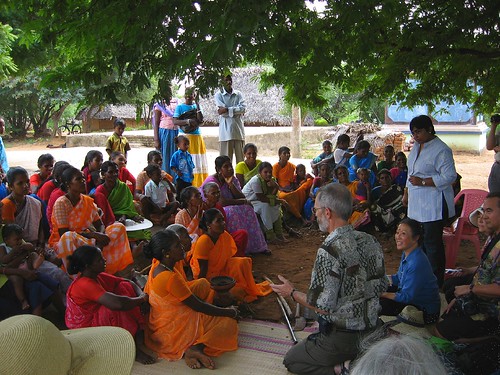
After our trip to the Kattaikkuttu school, we headed out to the countryside. We joked about going to the jungle (and if any lingering tensions within the group might turn into a Lord of the Flies moment), but it turned out to be mostly scrub forest (and thus the accidental geography of vegetation prevented our small band of travelers from devolving into anarchy).
As part of our desire for cultural exchange, and the government's and local NGO's to develop cultural tourism, we visited several Irula villages (the Irula are one of the aboriginal peoples of India who trace their ancestry back before Dravidian migrations) and got to swap stories.
In this photo, San Francisco storyteller Jeff Byers is sharing a story with the women of Chenneri, an Irula village in the Chenglepet district of Tamil Nadu. Storyteller Jeeva Raghunath translated between Tamil and English for us.
The story swaps were a highlight of the trip for me, and I'll be posting more thoughts on this portion of the trip soon.
February 01, 2008
Creative Loafing Atlanta: Spotlight on Storytelling
Journalist Curt Holman has the arts section cover story this week in Atlanta's alternative weekly, Creative Loafing, where he profiles local storytellers Carmen Deedy, Andy Offutt Irwin, Rob Cleveland, and Audrey Galex. The article juxtaposes the ancient art form against the latest technology... and leads with a story about Deedy at the TED conference. The brief article also manages to highlight other issues, such as the generation gap:
Professional storytellers are a diverse bunch, from Irish-style balladeers to African griots to tall-tale swappers. But one demographic consistently underrepresented is young people.
"I'm 52 years old," Cleveland quips, "or, as they call me in storytelling circles, 'The Kid.'"
Andy Offutt Irwin, a perpetually boyish singer/storyteller from Covington, notes that, "the good thing about storytelling is that it doesn't matter how old you are. The longer you live, the more you know.
"But there needs to be more young storytellers," he says. "My cousin who's 28 came to see me in Oklahoma City and afterward said, 'Andy, you're a rock star!' And I said, 'Yeah, but everyone's 55.'"
December 22, 2007
Thought Leadership in Practice: Storyteller.net

Sean Buvala recently asserted Storyteller.net has been around on the Web longer than Google. (To confirm that, I checked via the Internet Archive. Yup, by more than a year!)
Since the very beginning, Storyteller.net has aimed to be a clearinghouse on the Web, a "one stop shopping site" for information about storytelling. But rather than a top-down, "we know best" approach, from the very beginning, the site invited members of the storytelling community to contribute content, share tips, share stories, and spread the word about what they offer. Storyteller.net understands the collaborative nature of the Web, and has since the beginning.
The model works.
You can find more on-the-ground, in-the-field, helpful tips on the storytelling art and business aggregated here than on any other web site, period.
From the beginning, copyright of content submitted by contributors (articles, stories, audio) has remained with the contributor.
From the beginning, Storyteller.net has offered storytellers a web page, so that even the non-tech savvy teller could hang their shingle on the Web. (With a brilliant model for building the site: a storyteller could upgrade their listing on storyteller.net for a modest sum ($25/year) OR by contributing content. I don't know if the economics are working out, but that's a surefire way to build your site content).
They've hosted audio files so that people could hear stories online, and they've done it since 1997! Now, in 2007, that doesn't seem so "different," BUT in the storytelling world, it's far from common. (Whereas it's a no-brainer that any band in the 21st century wanting to have a go in the music industry has their music online so that potential audiences can hear it, the number of storytellers that even attempt this is ridiculously small).
You can quibble with the quality of the advice posted there (same as you can with any user-generated content site), but hey, if you don't like the advice in an article, write your own, and submit it. Odds are Storyteller.net will publish it.
The content on Storyteller.net may not be cutting edge-- it's meant to be more practical than philosophical, more personal than political. But in the storytelling realm, the mere existence of Storyteller.net is cutting edge. Hats off to Sean Buvala for thought leadership in practice.
Subscribe to:
Comments (Atom)