December 23, 2007

When is Storytelling Not Storytelling?

Before I continue with the shout-outs to various other blogs and web sites, I have to jump in with this reflection based on both an issue Sean Buvala raises about the defintion of storytelling, and a brilliant night of storytelling my wife and I caught last week.


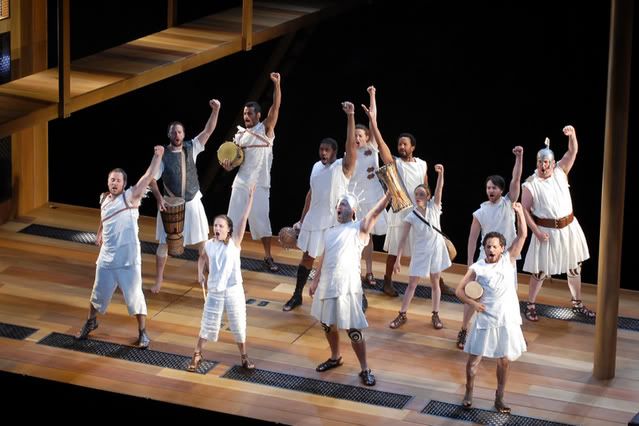
Mary Zimmerman's adaptation of The Argonautika, the ancient poem that re-tells the tale of Jason and the Golden Fleece, has been playing in town, at Berkeley Repertory Theatre. Mary's an old college friend and I'd go see anything she's directed. The two-and-a-half hour long production has been wowing crowds and critics alike.

Critics call the production full of theatrical wizardry... but Pat Craig of the Contra Costa Times, I think captured the show's appeal best: "...when writer-director Zimmerman spins the tale, it conjures memories less of musty schoolbooks and more of Saturday afternoon matinees and midnight campfire stories."

My wife and I both found the show one of the best performance events we've ever seen. But despite the fact that the show was produced in a proscenium theatre, I'd be hard pressed to call it a "play."

Sure, there were actors. Costumes. Lighting. A set. Excellent music. And props. And clearly, the performers had learned their lines. But the whole point of the evening was not to show off acting chops, or a well-written script. The whole point of the evening was to gather people in a room to share a story.

And in this, the effort was wildly successful.

It took a dozen people on stage (and a host more offstage) to share the tale of Jason and Medea. And Mary chose to use puppets, percussion, stagecraft, music, and drama to help in the telling of the story (But still, we, the audience members, were co-creators of the images of the story... the stagecraft did not try to re-create, but only suggest dragons, armies, storms, armadas).

That doesn't make it any less storytelling, in my view.

Granted, this type of storytelling does not fit into the storytelling circuit's model of concerts and festivals.

I can think of one, maybe two, "professional storytellers" who might, might, be able to get the same emotional wallop with this story.

The story was thrilling. It brought to life an ancient tale, while acknowledging our own modern day perspectives on fate, on war, on glory, on storytelling. It even acknowledges that we, as an audience, already know how Jason and Medea end up (most people in this theatre crowd knew the story of Medea... whether they knew the story of Jason and the Golden Fleece before entering the theatre was debatable...
I only knew it from the 1963 sword-and-sandals movie from Columbia Pictures (filmed in the miracle of Dynarama!) featuring the astonishing stop-motion animation of Ray Harryhausen. And you can be sure that Hollywood's version didn't exactly stick to the original story.)

For me, a listener who prefers ancient tales to "the day grandpa fell off the ladder," this was a remarkable evening of ensemble storytelling.

For me, it certainly falls within Sean Buvala's definition of storytelling:
Storytelling is the intentional sharing of a narrative through words and actions for the benefit of both the listener and the teller.


Some folks will say, well, no, it's theatre, not storytelling. They point to the costumes, the lights, the script. The sound design, the set, the choreography.

To me, that's like saying that modern dance isn't dance because it's not ballet. That Elvis Presley's oeuvre wasn't music because he didn't do it like Benny Goodman.

I understand the main objection of storytelling purists: that the conventions of theatre don't allow for spontaneous interplay with and reciprocal feedback with the audience.

But I was there. Sitting in a darkened space, with six hundred other people, transfixed, as an ensemble told us about Jason, and Pelias. Athena and Hera. Hercules, Castor and Pollux. Phineas. Aeetes. Medea.

They told us a story.

-----

BTW, catch the 30-second trailer for the show on YouTube.

December 22, 2007

Thought Leadership in Practice: Storyteller.net


Sean Buvala recently asserted Storyteller.net has been around on the Web longer than Google. (To confirm that, I checked via the Internet Archive. Yup, by more than a year!)

Since the very beginning, Storyteller.net has aimed to be a clearinghouse on the Web, a "one stop shopping site" for information about storytelling. But rather than a top-down, "we know best" approach, from the very beginning, the site invited members of the storytelling community to contribute content, share tips, share stories, and spread the word about what they offer. Storyteller.net understands the collaborative nature of the Web, and has since the beginning.

The model works.

You can find more on-the-ground, in-the-field, helpful tips on the storytelling art and business aggregated here than on any other web site, period.

From the beginning, copyright of content submitted by contributors (articles, stories, audio) has remained with the contributor.

From the beginning, Storyteller.net has offered storytellers a web page, so that even the non-tech savvy teller could hang their shingle on the Web. (With a brilliant model for building the site: a storyteller could upgrade their listing on storyteller.net for a modest sum ($25/year) OR by contributing content. I don't know if the economics are working out, but that's a surefire way to build your site content).

They've hosted audio files so that people could hear stories online, and they've done it since 1997! Now, in 2007, that doesn't seem so "different," BUT in the storytelling world, it's far from common. (Whereas it's a no-brainer that any band in the 21st century wanting to have a go in the music industry has their music online so that potential audiences can hear it, the number of storytellers that even attempt this is ridiculously small).

You can quibble with the quality of the advice posted there (same as you can with any user-generated content site), but hey, if you don't like the advice in an article, write your own, and submit it. Odds are Storyteller.net will publish it.

The content on Storyteller.net may not be cutting edge-- it's meant to be more practical than philosophical, more personal than political. But in the storytelling realm, the mere existence of Storyteller.net is cutting edge. Hats off to Sean Buvala for thought leadership in practice.

December 13, 2007

Where are the Thought Leaders in Storytelling?

If you want to learn about storytelling as an art form, good luck using the Web.

There are plenty of talented storytellers and storytelling mentors out there. Good resources: courses, books, conferences.

The national and regional conferences are excellent places to not only learn storytelling, but network with storytellers, and most importantly, hear from the "big picture" thinkers-- the folks who have been doing this for years, who care passionately about this, and have challenging ideas about where the American storytelling revival has come from, where it is now, and where it's going.

But, by and large, you won't find them online.

(One exception: the Storytelling in Business movement, which has been growing rapidly in recent years, where business leaders harness organizational knowledge through storytelling, narrative, and applying the lens of anthropological collection of folklore to the corporate organization, has always maintained a healthy presence online (in part, because it has grown contemporaneously with the Web, and in part because business folks are quick to realize (unlike many storytellers) the value proposition of being seen online).

Google the phrase, "storytelling," and see what resources are on the first page.

Today, the only single storyteller to appear on that first page, is Heather Forest. Since 2000, she's provided the world with Story Arts Online, a web site with resources for storytelling in the classroom. The site is customer focused, that is, its for teachers to use. It's actually difficult to find any info about Heather on the site and how to hire her (this may be intentional on her part-- after thirty years of performing, you might want to slow down).

You can find the International Storytelling Center... but the web site is a promotional and professional site for the Center's real-world site. Nothing wrong with that, but their web site is not contributing anything to the understanding of the art form.

The National Storytelling Network's site only appears on the second page (and I would argue that, though its mission is different that that of the ISC, its Web site is also not contributing anything to the understanding of the art form).

Granted, there's a problem with the query itself, as "Storytelling" is too broad a term to focus solely on the performing art.

But I would argue that the "thought leaders" of the storytelling field, apart from Storytelling in Business group, and Heather Forest, have abandoned the Web as a means of getting the word out.

Actually, "abandon" means that they were there in the first place. Hmm. What's the word I'm looking for?

"Ignored."

Take a look who's advertising on this Google results page in the right hand column for a clue as to who does understand the importance of Web presence: Doug Lipman, Aneeta Sundararaj, and Sean Buvala. Through Google's ad program, they have paid for links to their sites to appear on that front page.
(Today, the ad list also includes a link to an entertainment design firm... I suspect that they will find the clickthrough from the term "storytelling" disappointing)

I'm not sure why children's literature proponent Esmé Raji Codell's single page on storytelling in the classroom appears on the first page of results. It may be that Google's algorithm for ranking is simply weighting it more because the set of all web pages linking to it (presumably from educational web sites) is larger than the set of all web pages linking to any other storytelling web site.

So, our elders in the field are mostly ignoring the Web.

We can see them at Festivals, but there we usually only hear them tell stories. At conferences, we invite those in our community that we feel have wisdom to impart to be keynote speakers, or lead intensives, or workshops, but their thoughts, however valuable, are lost. Conference proceedings aren't published. Recordings are not disseminated.

So wisdom --or challenges to accepted wisdom-- appears once a year, at a conference in just one place, at one time. Maybe an abbreviated version appears in Storytelling magazine, but that's a dead end too (An article in storytelling magazine is akin to packing knowledge away in a crate never to be seen again, like at the end of "Raiders
of the Lost Ark). Coincidentally, via a used book trading website, I just found a grad student in the library program at University of Illinois who unearthered twenty copies of a state-of-the-field collection of white papers (from Joseph Sobol, Karen Morgan, Janice del Negro, et. al) circa 1998 which I'll be distributing to people who can use this info. If you want a copy immediately, UI has put the papers on the Internet Archive here. (Story, from fireplace to cyberspace : connecting children and narrative (1998). Allerton Park Institute (39th : 1997 : Monticello, Ill.))

In some cases, we have to wait multiple years while our leaders in our field write a book.

A book is not a conversation, and neither is a keynote speech.

Now, there are some folks in the storytelling community who blow my mind every time I talk with them. They're sharp, insightful, wise, and open to being challenged. And they do spread their vision, share it, pass it along... one on one, or in workshops, or at conferences.

But it's slooooow.

Enter blogging.

In many industries, notably the tech industry, authorities in the field write on the state of their industry via a blog.

If you're reading this, this is not news.

My favorite "industry" that's blogging right now is theatre. Some bloggers are
professional critics, some are amateur critics. Some are directors, some are producers, some are playwrights, some are in-the-trenches administrators. And they are having passionate discussions and arguments about the state of theatre in America, in the UK, in Australia. About the art form and where its going, why its dying, what's exciting and what's cutting edge and what's going to keep the theatre world alive.

And you can see, via the comments, and the blogs, that ideas are zipping back and forth. Arguments, agreements, conversations... all virtual, but they are happening.

And its not being driven by one institution, but by impassioned people who believe in an art form.

Does storytelling have these folks? Yes.

Are they blogging?

They're starting to. It's taking a while. (Heck, I registered this blog in 2000. It took me 7 years to get around to posting anything here)

But those that are using the Web are becoming de facto thought leaders of the storytelling movement.

Over the next few weeks, I'll be posting reviews, shout outs, and links to these blogs and podcasters, who are utilizing the Web the way it was meant to be used: as a way to share content, to participate in media, and as a way to reach out to those interested in a field and invite them to learn more.

Who these folks are won't be a surprise (I've had links on the left hand side of this blog for a while). But I do want to start a fire under the conversation, and, while we're at it, boost our respective Google rankings;-).

September 27, 2007

Not Your Mama's Bedtime Story


A school in my neighborhood is hosting their first ever storytelling festival in October. One of the parents there who is helping to organize it, is a local journalist, and thought this an appropriate time to do a survey of the local storytelling scene. She interviewed me via email, and later came to see a performance.

For someone writing about storytelling from the outside, I thought Autumn Stephens does a very good job... and kudos to the The East Bay Monthly for letting her go in-depth (the article weighs in at over four thousand words). (Link)

I'm hoping the photo here, by Lori Eames, helps get across the serious themes that stories can deal with, rather than encourage audiences to say "Hey, dude, when are you going to bring out the skull?"

September 25, 2007

Reflections from the Fringe: Improv Storytelling

So I've completed my run of You Go First at the San Francisco Fringe Festival, a show which was essentially an experiment conducted on the hypothesis that if you drop two experienced actors with a long history of improvisation on a stage with no script, no games, and no suggestions from the audience, that something interesting would happen.

We would create scenes in the moment, and either play them until the lighting technician turned out the lights, or we both left the stage. What happened next is that one or two of us would come back out onstage and start a new scene.

Often I would enter to start a new scene having no idea of how to set the next scene. For one thing, if I entered first, I had no way of knowing if my partner was going to come out and join me for a two person dialogue, or if I should start a monologue.

A few observations about the kinds of stories we ended up creating:

1. Many of our stories involved characters who used the Web to conduct part of their daily lives (whether it was looking up an address for a store to checking email to blogging to reading Wikipedia). The immediate challenge was the question of how do make that theatrically interesting? Because a stage picture of someone sitting down at a computer is not that compelling.

We figured that out quickly-- you make the search for information have high stakes-- essential to the character, so that the narrative depends on how this character reacts to finding or not finding this information.

I found it interesting the way different audience members reacted to our references to the digital landscape. On one night, blank looks from a couple in the audience made it fairly clear that the term "Wikipedia" held no meaning for them. On another, a reference to "poking" got giggles from a few in-the-know Facebook members in the audience, but if you were in the audience that night and aren't on Facebook, that phrase didn't have any meaning to you (although we made sure it did to the characters we were playing). Later in the show my partner did a monologue about MySpace in which he described what one could do with MySpace, mainly because it fit with the theme of the show we were creating (the theme of identity, and how we present ourselves to the world) but happily it gave context to those in the audience who weren't familiar with it.

Given that we were performing in San Francisco, a very "wired" city, we made a lot of presumptions about the extent that digital devices permeated our audiences' respective lives. No doubt we were guilty of overestimating the relevance of our own social networks.

But storytelling is filled with opportunities to introduce new words and new cultures. In fact, that's one of the benefits that storytellers hype when they try and drum up business in schools. Your students will learn new vocabulary, learn about cultures that are new to them....

Being aware of this, I once asked a group of fourth and fifth graders, "Do you know what a jackal is?" A few did, and volunteered that information with the group, and then I started with "This is the story of the Brahmin, the Tiger, and the Jackal."

"What's a Brahmin?" three of them cried in unison. My own children are similarly inclined to interrupt me at every opportunity to learn a new word.

Actually, I had to remove the term "crone" from my adult version of Rapunzel, because adults in my audience (even the storytellers!) didn't know what that word meant (and truth be told, I introduced the word in the moral to the story, so there wasn't enough context to decipher that I was referring to the witch who had imprisoned Rapunzel).

2. One of the storytellers who came to see the show was fascinated with the moments in between the words. "You two were listening so well to each other you could almost see it," she told us.

In the absence of a script or game, listening is the most valuable tool an improviser has onstage.

But I think that it has been my experience storytelling that allowed me to be comfortable standing onstage, in front of an audience, and not saying anything. The improviser inside me knew a story would come out eventually. The storyteller in me trusted that the audience could wait.

I don't think a handful of seconds is an unreasonable amount of time to not say anything onstage. Would you be comfortable not saying anything for 5 seconds in front of your audience? for ten? fifteen?

3. In improv, we're trained to jump to the next most obvious scene. If we set up audience expectations that a story will go somewhere, we should go somewhere, rather than delay.

In one story, where my character was convinced that another was stealing/dissolving my identity in bits and pieces, we chose to draw this story out, adding depth and color and backstory. Seeing how my character was dealing with other people besides his antagonist. Yes, it was delaying the inevitable. But I don't regret adding the extra texture. I like to think it made the inevitable final scene more satisfying.

In the moment I was mostly focusing on what was happening right then and there, but I knew in the back of my mind that we already made the call of how the story could end (my character would disappear completely) and the question was back there: when would we do that scene, if at all?

Funny how in traditional storytelling, knowing the ending ahead of time (we know how Jack and the Beanstalk is going to end-- and stick around long enough, you start to internalize the Aarne-Thomson tale types, and think, oh, this is AT 1620, I know how this will turn out) doesn't take away from the experience.

In fact, and I can't remember who said this (Duncan Williamson???? I'll have to track it down)-- knowing the ending and knowing the plot points are an essential part of enjoying traditional tales.