In case you're a visual thinker, or use mind maps, check out Pearltrees. It's a visual way to organize your Web surfing. I've started a pearltree on storytelling (wait for it to load, and then mouseover and/or click around):
If you like what you see, especially if you're a visual thinker, sign up, and join in. I'd love other minds curating this collection.
February 11, 2011


December 18, 2010
Interview with a Rock and Roll Storyteller
Following up on my earlier review of "Dizzy Miss Lizzy's Roadside Revue presents Finn McCool," I'm sharing an interview with one of the company's founders, Debra Buonaccorsi. First, here's a description of how D.M.L.R.R. describes itself:
Dizzy Miss Lizzie’s Roadside Revue is theatre and vaudeville. It’s rock and roll, bluegrass and Americana. It’s the spirit of Woody Guthrie and the dustbowl wrapped up in a gyspy punk. The spirit of the vagabond and the rebel. They are the voice of human kind’s savage soul. It’s pure storytelling with bare hands and authentic voices. Storytelling cranked up good and loud through a Telecaster and a Marshall amp.
DMLRR was founded in Washington DC by veteran actor/musicians Debra Buonaccorsi and Steve McWilliams. Led by their common love for theatre, rock and roll, and the traditions of American music and storytelling, they sought to bridge the gap between a night at the theatre and a rock concert.

Pictured: Debra Buonaccorsi (foreground) and Steve McWilliams (R) in "Dizzy Miss Lizzy's Roadside Revue presents Finn McCool" at the Capital Fringe Festival, July 22, 2010. Photo copyright 2010 by Paul Gillis Photography; used by permission.
How did you first hear about Fionn mac Cumhaill? And what was the inspiration to bring his origin story to life with a rock and roll show?
It was an idea that Steve and I had been tossing around for a while- we'd never nailed it down to one particular Irish legend. I was into all things Irish in high school- literature, music, culture, Bono etc… and my sister, upon returning from a trip to Ireland, brought me a book called Gods and Fighting Men, which was a book of Irish Mythology compiled by Lady Gregory (a good friend of William Butler Yeats). The stories were odd and funny, as mythology usually is, but they stuck with me. When my good friend Laura Keena, the actress who played the Druidess Bodhmal in the show, brought Finn McCool up as a possible subject for a DMLRR show, I was instantly inspired. Laura’s parents have this amazing wood carving that they brought back from their honeymoon in Ireland, of the Finn McCool legend. It has the faces of Finn and Finneces carved out, there’s a salmon in there somewhere. So, the Laura and I set off to googling Finn McCool, and called Steve. Being of Irish descent and having spent time in Ireland, Steve was familiar with Finn and loved the idea.
Rock and roll is an essential part of the DMLRR aesthetic. There is something so “everyman” about rock music. It’s unpretentious, unadorned, high energy, it’s visceral and cuts to the chase. That’s why we feel it suits us and our storytelling. The extra added bonus of Irish legend and rock music is that there was so much inspiration in Irish music and Irish rock music. The Irish have been telling great stories through music for centuries- so we thought it was a perfect marriage.
Did you consciously view this show as storytelling, as opposed to a rock opera, or a musical, or a live concept album?
We hate to think of ourselves as musical theatre. We do have the concept album in mind when we’re writing. We’d like all of our music to be able to stand alone as a concept album, without a script, in the tradition of The Who’s Tommy or Pink Floyd’s The Wall. We do think of ourselves as storytellers. It gives us license to have fun and play and interact with the audience; it frees us from the confines of “theatre.”
Were you worried about the audiences knowledge of this story (or lack thereof)?
Maybe we should have been more worried. There was a mention in a review about “barely decipherable Irish names.” That’s never stopped people from understanding Chekhov, and those are barely decipherable Russian names. Most of the negative comments about the show have been about the confusing story and names. I thought it was pretty simple stuff. We’re thinking in the re-write that we would add a story song to get all of the necessary exposition and background out. We’re also thinking of using multi-media “cave painting” -esque drawings to assist in that area.
What does the rock and roll revue format give you artistically that traditional musical theatre doesn't?
Both Steve and I have spent a lot of time in the musical theatre world and we both have grown dissatisfied with its limitations and conventions and we question the cultural relevance of musical theatre as an art form. We started out trying to tap into the traditions of vaudeville and burlesque—“low” forms of entertainment and we’re both rock and rollers—also considered a “low” form—in fact, I recently heard rock and rock described as a “derivative” form of music. Which I had to laugh at: what isn’t derivative? We’re all walking derivatives. Anyway, as I said earlier, the rock and roll revue format gives us freedom to have fun and be loose. There’s so much energy and immediacy in a rock show. Someone once said after seeing one of our shows, that we weren’t acting like we were having fun: we WERE having fun. Steve and I call Dizzy Miss Lizzie’s Roadside Revue our playground. We simply invite others to come and play with us on our playground. You can play with us, or if you don’t like our games, you can take your ball and go home.
If you live in or near the Washington DC area, you can see the show again in 2011: DMLRR has recently completed a Kickstarter fundraising campaign to self-produce "Finn McCool" in March at the Woolly Mammoth.
November 23, 2010
Shout Out: Dizzy Miss Lizzy's Roadside Revue - Finn McCool
As an out-of-towner at the Capital Fringe Festival in Washington DC this past July, I had minimal information to go on in selecting which of the 137 productions to see. I did what research I could, visiting performer's websites, paying attention to local reviews... but with limited time and money, I mainly chose based on content: what was the show about? When I discovered, on the Fringe web site, that there would be a "post-apocalyptic, raucous, rock and roll, retelling of the Irish legend: Finn Mc Cool" by a group called Dizzy Miss Lizzy's Roadside Revue, I made time in my schedule.

Now, as a storyteller, I'd certainly heard of Fionn mac Cumhaill (my Celtic storytelling colleagues would never forgive me if I didn't use the Gaelic spelling). Over the years, I had heard a tale here or there of this Irish warrior-king of the Fianna, but I'd never read or heard Finn's origin story (And, truth be told, hearing one too many versions of the tall tale where Finn meets Cuchulainn did not inspire me to seek it out). So now here, I hoped, in DC, I'd get to hear it... gathered in the darkness with strangers to hear a story.
Only we weren't gathered in the dark. We were in a portable tent (a good omen for storytelling) set up as a temporary venue constructed for the duration of the Fringe, with a massive soundsystem (so it could double as the party spot) and a roof to keep the summer thundershowers off the outdoor thrust stage (seating on three sides). Though not air-conditioned (and in DC in July, that fact made it into every review of each show that played there), the venue was conveniently located next to the Fringe bar.
The stacks of amps, full drum kit, microphones, and numerous electric guitars on the stage made me realize this was not going to be your average storytelling set. The programs and postcards for the show set up the frame that the legend of Finn McCool would be presented as a rock and roll revue with six bands on the bill (With just 8 performers in the show, the "bands" were created with costume changes and sometimes switching up instruments).
And so, in music and song, we were treated to Finn's origin story: how his father, leader of the Fianna warriors, was killed by Goll Mac Morna; how his mother gave him up to be raised in secret by the druidess Bodhmall and the warrior woman Liath Luachra; and how Finn obtains the Salmon of Wisdom during his service to the poet and teacher Finneces, which enables him to claim his place as leader of the Fianna and defeat Goll.
Plot points were kept to a minimum to let the music do the heavy lifting of the show: and it worked. The music ranged from ballads (both acoustic and power) to art rock to stadium rock to blues... the troupe used a wide musical palette to vary the emotions through the arc of the story, and the audience cheered every time they recognized a trope (e.g. guitar solos, power duets, drinking song choruses). I was also impressed by the quality of the performers (though the show had a thrown-together, held-together-with-duct-tape thrift-store aesthetic, everyone in it, from the costumer to the composer to the performers had bona fide professional theatre chops). The singers--most with musical theatre backgrounds and many recognized by local critics and peers with theater awards--really delivered, as the variety of songs explored a vast emotional range.
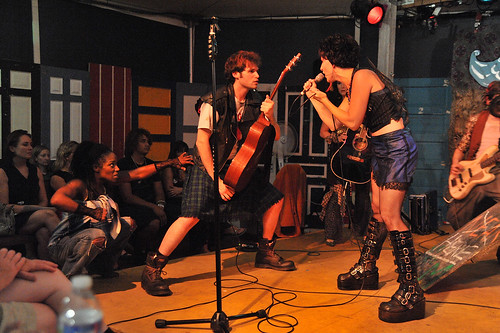
Pictured: Audience and Felicia Curry, Matthew Schleigh (as Finn), and Debra Buonaccorsi. Photo copyright 2010 by Paul Gillis Photography; used by permission
This show called to mind ancient traditions of epic storytelling, where the community gathered to listen to stories of heroes, and achieve an altered state of consciousness. At the Fringe, our consciousness was being altered not only by our willingngess to engage with the drama, but the soaring melodies and the volume of the music, but by the venue's heat, humidity, and proximity to the performers (no one was farther than 15 feet from the stage). The availability of alcohol helped, too.
Furthermore, the posturing and tropes of rock and roll passed for modern day versions of the ritual required for the sharing of such epics. So, while in an oral culture, everyone in the audience would know the story (e.g. the Ramayana) , this performance gave the audience a story in a style everyone knew, though many weren't familiar with the characters or plot.
The creators of the show made sure that before and after each song, characters explained who they were, what they wanted, and where they were going. The extra exposition here was necessary for an audience unfamiliar with this epic. Some reviewers complained that the exposition muddied the dramatic arc, but I found it was not only necessary to get the story out, but actually a clever way to continue to build the trance state you want in an epic storytelling session (My own theory: by giving the logical brain narrative, we're compelled to engage more--to find out what happens next-- which allows us to continue in the performance environment towards a trance state).
Me? I’m predisposed to enjoying epic narration (my list of most enjoyable theatrical experiences include narration heavy shows like lookingglass theatre’s Argonautika and Metamorphoses, and Mabou Mines’ Peter and Wendy… and to which, I’m adding this production), so my enthusiasm for this show might differ from the typical DC theatregoer, but all in all... I found it a thoroughly delightful way to engage with an ancient myth, and in terms of artistic craft, an inventive and masterfully crafted performance experience.
If you're not in the DC area (and won't get a chance to see future productions of Finn McCool), you can get a mere taste of it: Check out this Flickr slide show with Paul Gillis' photos (link) while you play music from the show via DMLRR's page on Myspace. (The versions there are clean, but nowhere near as thrilling as hearing them performed live by sweaty rock and rollers a stone's throw from you!)
Coming up soon: an interview with one of the show's creators, Debra Buonaccorsi

Now, as a storyteller, I'd certainly heard of Fionn mac Cumhaill (my Celtic storytelling colleagues would never forgive me if I didn't use the Gaelic spelling). Over the years, I had heard a tale here or there of this Irish warrior-king of the Fianna, but I'd never read or heard Finn's origin story (And, truth be told, hearing one too many versions of the tall tale where Finn meets Cuchulainn did not inspire me to seek it out). So now here, I hoped, in DC, I'd get to hear it... gathered in the darkness with strangers to hear a story.
Only we weren't gathered in the dark. We were in a portable tent (a good omen for storytelling) set up as a temporary venue constructed for the duration of the Fringe, with a massive soundsystem (so it could double as the party spot) and a roof to keep the summer thundershowers off the outdoor thrust stage (seating on three sides). Though not air-conditioned (and in DC in July, that fact made it into every review of each show that played there), the venue was conveniently located next to the Fringe bar.
The stacks of amps, full drum kit, microphones, and numerous electric guitars on the stage made me realize this was not going to be your average storytelling set. The programs and postcards for the show set up the frame that the legend of Finn McCool would be presented as a rock and roll revue with six bands on the bill (With just 8 performers in the show, the "bands" were created with costume changes and sometimes switching up instruments).
And so, in music and song, we were treated to Finn's origin story: how his father, leader of the Fianna warriors, was killed by Goll Mac Morna; how his mother gave him up to be raised in secret by the druidess Bodhmall and the warrior woman Liath Luachra; and how Finn obtains the Salmon of Wisdom during his service to the poet and teacher Finneces, which enables him to claim his place as leader of the Fianna and defeat Goll.
Plot points were kept to a minimum to let the music do the heavy lifting of the show: and it worked. The music ranged from ballads (both acoustic and power) to art rock to stadium rock to blues... the troupe used a wide musical palette to vary the emotions through the arc of the story, and the audience cheered every time they recognized a trope (e.g. guitar solos, power duets, drinking song choruses). I was also impressed by the quality of the performers (though the show had a thrown-together, held-together-with-duct-tape thrift-store aesthetic, everyone in it, from the costumer to the composer to the performers had bona fide professional theatre chops). The singers--most with musical theatre backgrounds and many recognized by local critics and peers with theater awards--really delivered, as the variety of songs explored a vast emotional range.
Pictured: Audience and Felicia Curry, Matthew Schleigh (as Finn), and Debra Buonaccorsi. Photo copyright 2010 by Paul Gillis Photography; used by permission
This show called to mind ancient traditions of epic storytelling, where the community gathered to listen to stories of heroes, and achieve an altered state of consciousness. At the Fringe, our consciousness was being altered not only by our willingngess to engage with the drama, but the soaring melodies and the volume of the music, but by the venue's heat, humidity, and proximity to the performers (no one was farther than 15 feet from the stage). The availability of alcohol helped, too.
Furthermore, the posturing and tropes of rock and roll passed for modern day versions of the ritual required for the sharing of such epics. So, while in an oral culture, everyone in the audience would know the story (e.g. the Ramayana) , this performance gave the audience a story in a style everyone knew, though many weren't familiar with the characters or plot.
The creators of the show made sure that before and after each song, characters explained who they were, what they wanted, and where they were going. The extra exposition here was necessary for an audience unfamiliar with this epic. Some reviewers complained that the exposition muddied the dramatic arc, but I found it was not only necessary to get the story out, but actually a clever way to continue to build the trance state you want in an epic storytelling session (My own theory: by giving the logical brain narrative, we're compelled to engage more--to find out what happens next-- which allows us to continue in the performance environment towards a trance state).
Me? I’m predisposed to enjoying epic narration (my list of most enjoyable theatrical experiences include narration heavy shows like lookingglass theatre’s Argonautika and Metamorphoses, and Mabou Mines’ Peter and Wendy… and to which, I’m adding this production), so my enthusiasm for this show might differ from the typical DC theatregoer, but all in all... I found it a thoroughly delightful way to engage with an ancient myth, and in terms of artistic craft, an inventive and masterfully crafted performance experience.
If you're not in the DC area (and won't get a chance to see future productions of Finn McCool), you can get a mere taste of it: Check out this Flickr slide show with Paul Gillis' photos (link) while you play music from the show via DMLRR's page on Myspace. (The versions there are clean, but nowhere near as thrilling as hearing them performed live by sweaty rock and rollers a stone's throw from you!)
Coming up soon: an interview with one of the show's creators, Debra Buonaccorsi
September 15, 2010
Gemma Hannah's Online Storytelling Challenge
Storyteller Gemma Hannah of London has put out a call for storytellers: storytellers who are willing to collaborate-- via video-- on a multi-teller version of Anansi and the Box of Stories. Watch her version (see below), then post a video of your telling (on Vimeo). Once she has a variety of versions, she'll produce an edited version featuring storytellers from around the world.
More details at storyweb.co.
Can't quite picture how this will work? Check out John Liu's film "The Art of Storytelling": link
September 10, 2010
Storyteller Jay O'Callahan on Imagination, Listening, and Appreciation
The 99% has posted a talk by storyteller Jay O'Callahan, in which he shares some of his process for developing stories. Included is an excerpt from "Forged in the Stars," a story commissioned by NASA on the occasion of its 50th anniversary.
The audience for this talk aren't storytellers, so O'Callahan's simplifies his process greatly (you would too, if you only had 20 minutes to explain what you do), but notice how the story he tells to illustrate his point is a story about storytelling. In his telling, he's not telling the story of the moon landing, he's telling the story of Neil Armstrong telling the story of the moon landing.
The audience for this talk aren't storytellers, so O'Callahan's simplifies his process greatly (you would too, if you only had 20 minutes to explain what you do), but notice how the story he tells to illustrate his point is a story about storytelling. In his telling, he's not telling the story of the moon landing, he's telling the story of Neil Armstrong telling the story of the moon landing.
Subscribe to:
Posts (Atom)