Showing posts with label adults. Show all posts

April 09, 2013

Shout Out: “Bawdy Storytelling” Turns Six

 
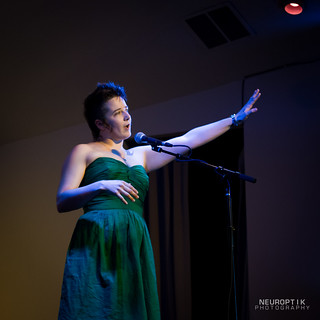
BAWDY_02.16.2013_SCANDALOUS_BLYTHEBALDWIN-2
Blythe Baldwin tells a story
at Bawdy's Sixth Anniversary Show
Photo credit: Queerly Yours
  As I walked into San Francisco’s Verdi Club on a recent Saturday night, every single one of the 300 seats in the venue was full; it was standing room only for a night of storytelling.    There was an excited buzz in the air, helped along by a live DJ and the Club’s full bar. If you had been there, you would certainly have recognized the familiar conventions of a traditional storytelling event: the friendly emcee with a Southern accent welcoming “y’all,” an opening song referencing several fairy tale characters; and then the stories on stage: a story about dealing with parents; a story about a challenging first day on the job; a memoir of a journey to self-discovery, love, and family; and a tale of “how we first met.”
  The fact that Swedish public television had a camera crew to cover this event might have been your first clue that this would not be your ordinary night of true stories.  
  The second clue might be in the details: those stories I mentioned about parents, work, love and meeting also happen to involve, respectively: a gynecological exam, prostitution, transsexuality, and animal role play and fetishism. 
  And that was just the first half of the show.
  Welcome to Bawdy Storytelling, the nation’s original live storytelling series featuring true stories about human sexuality. 
      Dixie De La Tour, the show’s producer, founder, and emcee, started Bawdy Storytelling six years ago. It was originally an informal story swap, a coffee klatsch for her friends in San Francisco’s vibrant sex-positive community.
  But as audience interest from others grew, “I started curating the storytellers,” says De La Tour. “I could get more people to come if they could see in the program that they themselves weren’t on the bill.”  
  As a producer, much of De La Tour’s time is spent recruiting storytellers. Apart from a handful of professional authors, poets, stand-up comics, and storytellers who appear on the Bawdy stage, most of the time she gets ordinary people to tell their stories. There’s no shortage of “real people” in San Francisco who have an interesting sex life. 
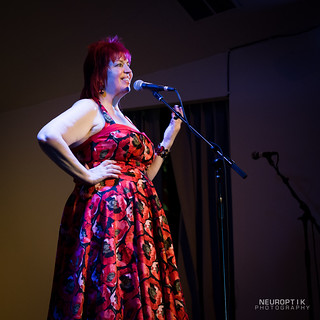
BAWDY_02.16.2013_SCANDALOUS_DIXIE-15
Bawdy Storytelling Founder Dixie De La Tour
Photo credit: Queerly Yours


  Once she finds a willing storyteller, then it’s coaching time: De La Tour works with her tellers to hone the story down to its essence, cutting away asides and dead ends, and encouraging her tellers to focus not on a polished monologue that you might hear at The Moth, but on telling as if you were at a party sharing your best story with friends. She has them make a visual map of their story, a story board, to help with structure. Finally, the six tellers featured at a particular event come together for a rehearsal. During the actual show, De La Tour remains onstage with her tellers, to give them support (the tellers might very well be uninhibited when it comes to sexuality, but even the uninhibited can be afraid of public speaking) and to provide a friendly face to tell to (the stage lighting makes it difficult to see the seated audience).
  By and large, the tellers play to a receptive audience. 
  But depending on your comfort level with the subject of sex, the show may not be for you. As an audience member, you will hear intimate details of the performers’ sex lives, told live, in public, with words you may not be accustomed to hearing spoken aloud in public. (The level of profanity varies from teller to teller, but given the subject matter, the language is always colorful and often graphic). The images and situations that come up in the stories can be edgy, even shocking. 
  But the goal of Bawdy has never been titillation. It’s about celebrating sexuality, in all its diversity, through storytelling. (Admittedly, that pitch does not sell as many tickets as the tagline, “The Moth for Pervs,” quoted from an LA Weekly review).
     It’s often the case that audience members might hear about experiences that they may never have conceived were possible. De La Tour likes the idea of expanding people’s perceptions. “My hope is that an audience member may hear about an experience, maybe something they’ve never imagined, and they get interested, and they can go up and talk to that storyteller and find out more.” (Indeed, at the show I attended, I saw several curious audience members at intermission pepper one of the storytellers with questions about the leather-clad “human puppy” that she had on leash that night).
  Mosa Maxwell-Smith, a storyteller and improviser from Oakland, described listening to stories at Bawdy in this way: 
"I can be a very judgemental person. I can't imagine having anything in common with some people when I first meet them, but then I hear their stories and—wow—my mind is blown! I love it when a story shatters my preconceptions and allows me to feel deeply connected to someone I otherwise might not have ever known."
  As for the future of Bawdy, De La Tour continues to recruit storytellers. She has added a “Bawdy Slam” night as a way to encourage more people to share their stories. She’s recently inaugurated a Bawdy series in Los Angeles, and is working on BawdyTalks (TEDTalks for the sex-positive community).  
  I asked Blythe Baldwin, a slam poet and visual artist from San Francisco who has performed at Bawdy many times, to sum up its significance to the community: 
"The importance of Bawdy, as a storyteller and an audience member, is that it offers catharsis in an area that many of us keep secret of out of shame or fear.  When you tell a story, you speak truth to life, and when you own your sexual experiences you own the very thing that makes you human: your wishes, your desires, and your capacity to love. Bawdy brings people together through all of that."
  Learn about upcoming Bawdy Storytelling shows at www.bawdystorytelling.com.

August 17, 2008

Shout Out: massmouth

(yet another post in which I editorialize on a storytelling project thousands of miles away from me which I have not seen)

Cheers to Nora Dooley, Doria Hughes, and all those Massachusetts tellers involved in massmouth, a new project to produce and promote storytelling events in central Massachusetts.

Keep up with them at their blog, their Ning site, and their YouTube Channel.

My editorial comments: great idea, keep up the good work. Can't wait to see where this leads.

June 04, 2008

Shout Out: YouTube's Canal Narradores

Congrats to Martha Escudero and her fellow storytellers over in Barcelona. Her YouTube Channel just made the midday news in Barcelona (you can skip ahead to 1:15 in the clip, from Televisió de Catalunya) as a must-see online destination.

Since Canal Narradores (that's "Storyteller Channel" in English) came onto YouTube 9 months ago, it has set the standard for quality production for traditional storytelling on YouTube. Even if you don't speak Catalan or Spanish, check out some of the storytelling videos. Not knowing the words, you'll actually learn a lot about gesture, voice, inflection, and pauses... and what works on the small screen. You can also see how quality sound, lighting, and camerawork enhances the performance.

And if you're going to be in Barcelona, don't miss Martha's storytelling series for adults, Contes i Cuentos, at the Harlem Jazz Club.

(Learn more about Spanish and Catalan storytelling at the ANIN, (Associació de Narradores i Narradors) website, which includes a directory, links to storytelling festivals and groups, and articles from their past newsletters.)


May 14, 2008

2nd Story: A Great Idea

A follow up to my previous post.

Normally, I wouldn't rise to the bait of an anonymous poster, but she called me on my snark, and this made me realize something that Sean has commented on before: from my blog postings, the reader can't tell what I actually feel about a subject. So here's an update.


Over in Chicago, Serendipity Theatre Company's got a good thing going with 2nd story, a monthly series and annual festival featuring personal storytelling at a popular wine bar. It sells out. It gets good press. It develops writers' performance skills and actors' writing skills. It celebrates the art of the well-told story.

And storytelling plus wine? That's a damn good idea. I wish more o.g. storytelling events featured wine.

Would that any venue I tell stories in is featured in a Zagat guide.

Jealous much? Yes, I am.

Because the old school storytelling community has missed the boat on this one. Dropped the ball. I looked at the roster of 2nd Story's storytellers. I looked at the behind-the-scenes organizers. I looked at the sponsors. Don't see any of the old guard. I can see storytellers skipping over WNEP's Skald (it's off-Loop, it's fringe, it's under-the-radar). I don't see how they could have missed this one.

(Am I missing something from two thousand miles away, just relying on Google? Yes, yes I am. Fill me in, Chicagoland people)

In my previous post, my use of the word "cringeworthy" wasn't a swipe at Ms. Stielstra, for her definition of storytelling. It was a swipe at the Chicago Storytelling Guild, who are either invisible or irrelevant in the Chicago arts community.

My remarks on the wine tasting at 2nd Story wasn't meant to be a swipe at the event. I just don't understand (not being an experienced wine taster or frequenter of wine bars myself) how the wine tasting and the storytelling go together. An organized wine tasting seems to me much more formal and stuffy than the communal, relaxed vibe that the storytelling can bring out. But I haven't been there. It works for 2nd Story.

2nd Story shows two things about the American Storytelling Revival:
1. That the Jonesborough, Tennessee-centric movement that started 35 years ago has narrowed its vision and become so inward-focused that it misses opportunities to connect with new audiences. (I've been saying this on the blog since the beginning)
2. The Revival of Storytelling will continue without them. The theatre and literary community, in recognizing the power of the personal story, are celebrating the art of storytelling. Hell, the business community, from "knowledge management" experts to marketing and branding gurus are carrying the storytelling torch, too (to my chagrin).

So, I apologize for not being clear.

But just we know, going forward: I've got my own biases and preferences:

I don't particularly care for personal memoir as a genre. (As if that's not clear already from my numerous entries on the toopic)

And reading a story out loud off of a piece of paper is storyreading, not storytelling, and isn't a performance art. And putting it on YouTube doesn't make it a better experience.

I like wine.

May 12, 2008

2nd Story: Story, Music, and Wine Festival

"12 days. 54 stories. 46 storytellers. And 5000 glasses of wine."

Now that's a storytelling festival I'd like to see!

Where? Chicago.
When? Last month. Just missed it. (They do have a monthly series)
What the--?

The best stories I’ve ever heard come from hanging out with friends over a good bottle of wine. That’s when people really start talking, really get to the meat of their experiences—the wild beauty of it all, the destruction and the hope. That's the feeling we're going for: the crowd at Webster’s Wine Bar has the intimacy of my own living room and the crazy, wine-warm secrets that have been told there.”
—Megan Stielstra, Director of Story Development


Check out the video from the local news station:


I wouldn't call a wine bar the ideal venue for storytelling, but-- according to the bar's website, surveys like Zagat's give it a rating as a top night spot right up there with the Green Mill (one of Al Capone's former speakeasys and home of the infamous poetry slam). In that company, I wouldn't mind having that venue on my resume.

Oh, it's personal storytelling. Nevermind.

Cringeworthy moment 53 seconds in:
CLTV Reporter asks: "Is there a storytelling scene in Chicago?"
Festival director: "There's a really active theatre scene, and there's a really active literary scene, and what we try to do is-- kind of-- meet in between."

Okay, granted, this is an entertainment reporter, not Woodward & Bernstein, but the fact that this answer got a pass is telling: it means that there is no Chicago storytelling scene.

(I Googled "Chicago Storytelling" and hey, the Chicago Storytelling Guild came up first. But its site hasn't been updated since 2006. So in the unlikely event of a fact checker from CLTV trying to find background on storytelling... they'd skip right past the old guard and take 2nd story at its word.)

Although the video interview emphasized the performance, browsing through the other video clips on their site and on MySpace, I found the festival gives a pass to the writers... there's a lot of "storyreading" going on too. Maybe after the third glass of pinot you don't mind that the evening's entertainment is engrossed in a piece of paper held in her hand and is reading AT YOU.

(Sorry, the snark is slipping out. My guess is that the actors all memorize their stories and the writers have their crib notes in their hands.)

Learn more at their web site,
or their MySpace page,
or this TimeOut Chicago article.

This feature at CenterStage got me laughing. As if a wine bar wasn't a difficult enough venue, the festival takes a break between each teller to have everyone taste another wine. I guess you have to be there. Just the image, though, of the juxtaposition of the seriousness of which you're presenting flights of wine with the literal spotlight on the personal storyteller is giving me a spot of cognitive dissonance.

Still, I'd love to see this once. Anyone seen it?

April 18, 2008

Why Memoir? Part 3.2

Ruthanne Edward, from Ottawa:
I have noticed that The Moth style events (story slams etc.) are pretty much entirely personal stories and primarily a younger crowd than a typical storytelling event. I think this stems from what others have said about how people feel disconnected, don't have the same opportunity to tell their own and hear other's stories as in the past. We are also all coming from much more diverse backgrounds with different experiences than ever before. I think in this regard that personal stories serve two purposes. Hearing the stories of someone from a similar time, place or culture as you helps to reinforce your personal identity. Hearing the stories of someone from a different time, place or culture is new, exotic and hopefully helps you to begin identifying with them.


Me again.
Perhaps the appeal of The Moth's aesthetic (ten minute true stories from the teller's personal life (although recent squabbling in the blogging community over the veracity of Malcolm Gladwell's "true" story at The Moth seems to indicate that they don't let the "true" part get in the way of a good story) is this: the simple elevation of the well-done kitchen table story with a microphone and a spotlight (in a venue with a well-stocked bar) celebrates America's obsession with the cult of the individual.

And I suspect the resonance for The Moth's audiences is not just similar "time, place or culture" (because they go out of their way to find tellers with odd jobs and unique experiences to share) but similar reactions to experience. That is, it's the emotional content that resonates, not necessarily the contextual details. And in doing this, it validates the idea of the individual. (Although, the concept of "Everybody has a story to tell" is by no means exclusive to nightclubs in the Village)

And again, if you've got an underused storytelling muscle in your frontal lobe, it's easier to visualize a story set in a familiar milieu, be it New York in the 1990s or Middle American in the 1950s.

Why Memoir? Part 3.1

I posted the question as to why personal memoir was so popular to the Storytell Discussion list. Several folks replied, and I asked for and received permission from several of the responders to post their thoughts here.

Gregory Leifel, from Illinois, http://www.thrivingmoss.com and very very soon, www.AhhhFinally.com, wrote:
does anyone think the reason could also partly be society's obsession with the previously private side of others?

Now I'm sure everyone here is going to deny wanting to know anything about any celebrity, yet something is driving this celebrity/private side obsession. Is it transferring over to storytellers and the audience preferences? No, seriously. Are we more open to stories that approach how another person personally looks at life or life's challenges because we've been inundated with the private lives of many celebrities? Has it made it okay? Do we expect the truth, the whole truth, and nothing but the truth in all its ugliness and glory?

After all, fairy tales and literary stories make you reflect in an anonymous way. You don't know the characters personally, because they aren't real, but you learn lessons from their challenges. Now, similar messages within personal stories are perhaps more identifiable because the real live storyteller on the stage is just like you, real with tough challenges. (celebrities are real people living in an unreal setting). Non-fiction books outsell fiction, but they didn't used to. Is this a result of the information society? We just gotta know details? We expect to know, so tell tell tell?

My feeling, at least with the popularity of personal stories in the U. S., is that our youth over quite a number of decades is no longer exposed to fairy tales. Maybe the Britney Spears' and Paris Hiltons of our pop-culture are so characterized that they are the fairytale stories now. And somehow it's transfered over to how we all tell stories.


My response:
Interesting to compare the rise and fall of teen pop stars with the fortunes and misfortunes of princesses and youngest sons... but I don't think an obsession with celebrity is pushing the hunger for memoir.

(And what about this? We'll clamor for more details for TV memoirs, tell all biographies... there are no taboos in the publishing world. But onstage... plenty of topics are kept out. The whole truth? No way. Not at storytelling events. Just the nice stuff. The humorous stuff. The stuff that honors the bonds of family and love and wisdom and apple pie.)

I think you're closer to the mark, Gregory, with the ability to identify with the protagonists. Adults, particularly, may more easily relate to a personal story than an anonymous folktale character. Perhaps the audience member has reached certain age at which they recognize that they themselves are not as smart as you thought they were and so maybe just maybe this guy onstage knows something (or is sharing that the story of that self-same epiphany).
Or,
the audience member has an atrophied imagination, and path of least resistance is to follow the story that requires only the image of the very storyteller in front of you and the carefully described landmarks familiar from nostalgia.

March 10, 2008

"We Rock Stories. We Rock Them Hard."

How come Minneapolis/St. Paul has all the cool kids? This past weekend in the Twin Cities you could hear both the O.G. storytellers, and the new kids on the block:

http://www.rockstarstorytellers.com
http://www.myspace.com/rockstarstorytellers

The alt-weekly City Pages says:
Let's face it—storytelling may be the primordial art form, born at the dawn of language. However, modern performance telling, with its small but dedicated, heavily middle-aged audience, has just never managed the same level of cool as rock 'n' roll. But this year, a group of 10 younger local performance artists banded together to take back some of the cultural cachet storytelling deserves. Optimistically calling themselves Rockstar Storytellers, they come to the stage from a multiplicity of backgrounds, from mime to radio monologue to traditional theater to slam poetry to competitive speech. Laden with Fringe Festival credentials, the cast promises to not just twiddle your emotional dial, but to take a monkey wrench to your presuppositions about what storytelling should be.

Go monkey wrench!

Exclusive interview later this month.

September 27, 2007

Not Your Mama's Bedtime Story


A school in my neighborhood is hosting their first ever storytelling festival in October. One of the parents there who is helping to organize it, is a local journalist, and thought this an appropriate time to do a survey of the local storytelling scene. She interviewed me via email, and later came to see a performance.

For someone writing about storytelling from the outside, I thought Autumn Stephens does a very good job... and kudos to the The East Bay Monthly for letting her go in-depth (the article weighs in at over four thousand words). (Link)

I'm hoping the photo here, by Lori Eames, helps get across the serious themes that stories can deal with, rather than encourage audiences to say "Hey, dude, when are you going to bring out the skull?"